
 0
0
 0
0
Scrolling through Twitter or TikTok, it can feel like everyone’s chasing the next trending topic, but not every viral moment is what it seems. Recognizing the difference between real conversations and algorithm-driven hype helps you stand out in digital spaces. By separating common myths from genuine trends and understanding how fast misinformation can spread, you set yourself up for more meaningful, credible engagement online.
Table of Contents
- Trending Topics Defined And Common Misconceptions
- Types Of Trending Topics In Digital Media
- How Trending Topics Influence Audience Engagement
- Risks And Challenges In Explaining Virality
- Strategic Benefits For Brands And Communities
Key Takeaways
| Point | Details |
|---|---|
| Trending Topics Reflect Current Interests | Trending topics are shaped by timing, relevance, and emotional resonance, capturing what people care about in real time. |
| Misinformation is Common in Trends | Not everything trending is accurate; fast spread often leads to the circulation of false information before verification. |
| Engagement Strategies Vary by Platform | Different social media platforms require tailored approaches for engagement with trending topics, focusing on their unique dynamics. |
| Authenticity in Participation Matters | Genuine engagement in trends can enhance brand loyalty and community building, outperforming forced interactions. |
Trending Topics Defined and Common Misconceptions
Trending topics are conversations, events, or ideas gaining rapid attention across social media, news outlets, and online communities. They capture collective interest within specific timeframes—sometimes lasting hours, sometimes weeks—and shape how millions of people engage digitally.
Understanding what makes a topic trend requires recognizing that trending isn’t random. Timing, relevance, emotional resonance, and shareability all play roles. A celebrity scandal, political announcement, viral video, or unexpected news event can thrust a subject into the spotlight almost instantly.
What Trending Topics Actually Are
Trending topics emerge from real conversations happening across platforms. They reflect what people care about right now, not necessarily what matters most in the world. This distinction matters significantly.
Here’s what characterizes a genuine trending topic:
- Sudden spike in mentions: Search volume, social media posts, or news articles increase dramatically over a short period
- Cross-platform visibility: The topic appears on multiple platforms simultaneously—Twitter, TikTok, Instagram, news sites, Reddit
- User-driven momentum: Real people discussing and sharing the topic, not algorithmic manipulation alone
- Time-limited lifespan: Most trends fade within days unless continuously fueled by new developments
Trending topics reveal what captures public attention in real time, but popularity doesn’t equal importance or accuracy.
Misconceptions Holding You Back
Misconceptions about trending topics create problems. Poor decisions in online engagement, spreading misinformation, and missing genuine conversation opportunities all stem from flawed understanding. Research on misconceptions shows that people hold incorrect beliefs about trending topics regardless of their background or education level.
Here are the biggest misconceptions:
- Misconception 1: Trending means true. Just because something’s trending doesn’t mean it’s accurate, verified, or factual. Misinformation trends constantly.
- Misconception 2: Everyone’s talking about it. Trending topics often feel universal online but represent narrow demographics. A topic trending in your region might be invisible elsewhere.
- Misconception 3: Trends last forever. Most topics peak then vanish. Staying relevant requires understanding trend cycles, not chasing every conversation.
- Misconception 4: You must engage immediately. Jumping into trending discussions without context leads to embarrassing misunderstandings or spreading false information.
Why Misinformation Clusters Around Trending Topics
Comprehensive analysis of online data reveals that trending topics attract misinformation because speed matters more than accuracy when information spreads. Early sources often contain errors, unverified claims, or partial truths. By the time facts emerge, false versions already circulated widely.
Young adults especially face pressure to engage immediately. Staying silent feels like missing out. But trending discussions reward quick reactions, not thoughtful ones.
This creates a perfect storm: emotional reactions spread faster than corrections. A misleading headline reaches millions before the full story emerges. Your comment based on incomplete information gets amplified by algorithms.
Pro tip: Wait at least 30 minutes before sharing or commenting on a newly trending topic. Use that time to verify basic facts, check multiple sources, and understand the actual story—not just the sensationalized version.
Types of Trending Topics in Digital Media
Not all trending topics are created equal. Understanding the different categories helps you navigate digital spaces more strategically and engage with conversations that actually matter to your goals.
Trending topics break down into distinct types based on their purpose, origin, and impact. Each type triggers different engagement patterns and requires different approaches from users.
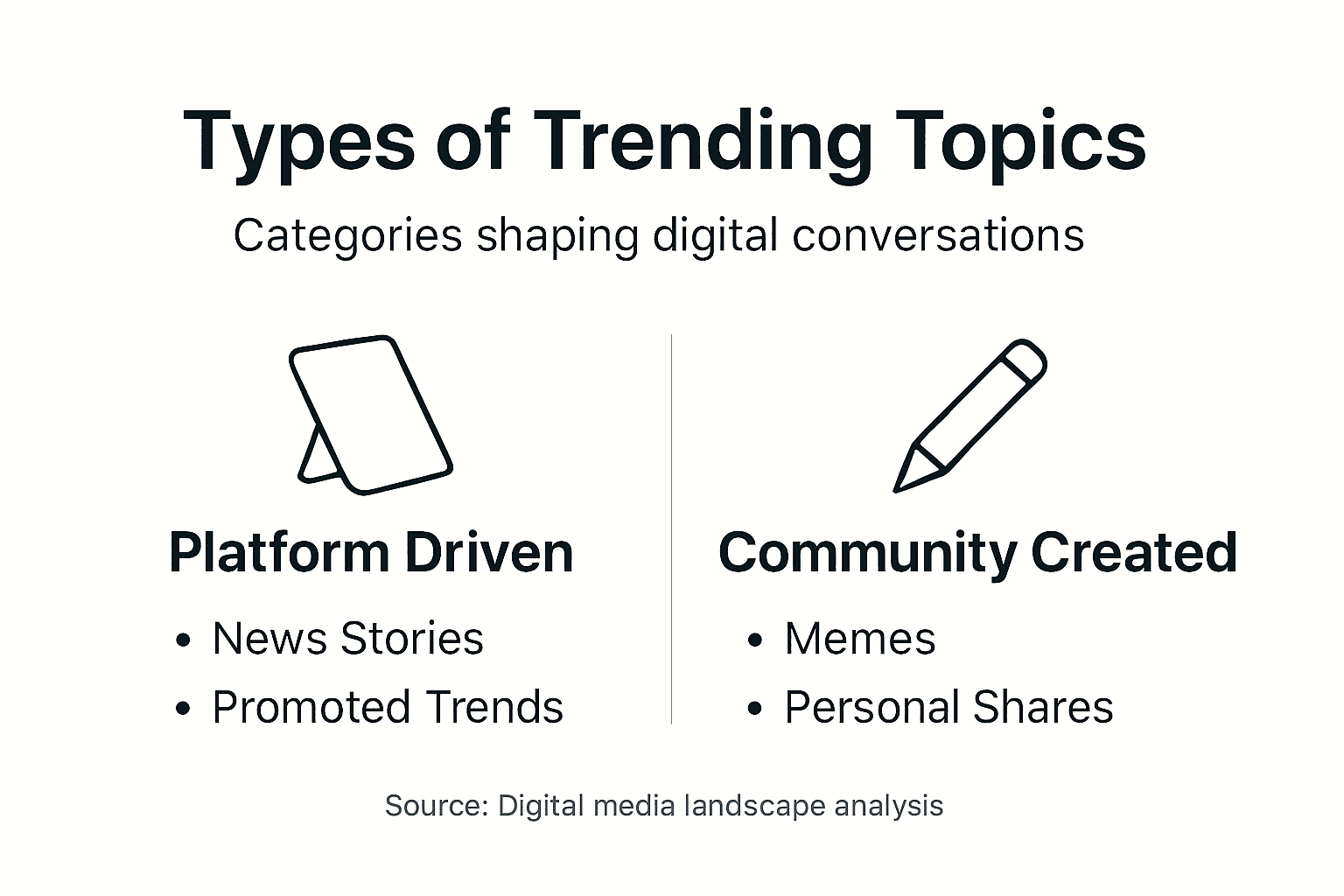
To clarify how different trending topic categories behave on popular platforms, here’s a summary table:
| Trend Type | Typical Platforms | Engagement Approach |
|---|---|---|
| Personal Expression | Instagram, TikTok | Share authentic stories or visuals |
| Promotional/Influencer | Twitter, Instagram | Identify sponsored or boosted posts |
| Informational/News | Twitter, Reddit | Verify facts before reacting |
| Cultural/Meme-Based | TikTok, Reddit | Remix, comment, participate playfully |
Personal Expression and Identity
These trends center on how people present themselves online and connect authentically with communities. Users drive these trends by sharing experiences, opinions, and creative content.
Examples include:
- Lifestyle moments: Daily routines, personal achievements, relationship updates
- Creative content: Challenges, art, music, humor specific to user communities
- Values-based discussions: Politics, social justice, environmental concerns
- Hobby communities: Gaming, fitness, cooking, fashion preferences
Personal expression trends feel organic because they emerge from genuine user behavior. People share without pressure—they want their audience to know who they really are.
Personal expression trends reveal authentic interests and values, making them powerful indicators of what communities care about beyond algorithms.
Promotional and Influencer-Driven Trends
Social media user management and influencer marketing effects shape a significant portion of trending topics. Brands, creators, and marketers intentionally amplify content to reach wider audiences.
These include:
- Brand campaigns: Product launches, promotional events, sponsored hashtags
- Influencer endorsements: Celebrity recommendations, lifestyle promotions
- User-generated marketing: Customers sharing authentic experiences with products
- Paid amplification: Content boosted through advertising platforms
These trends often feel manufactured because they are. Recognition matters here—knowing when you’re seeing promoted content helps you evaluate its authenticity.
Information and News-Based Trends
These trends emerge from real events: breaking news, political announcements, natural disasters, or major announcements. Speed defines this category—information spreads rapidly as events unfold.
Characteristics include:
- Breaking news: Events happening in real time
- Official announcements: Government, corporate, or organizational statements
- Crisis situations: Emergencies requiring immediate public awareness
- Verification challenges: Misinformation spreads alongside accurate reporting
Academic research and practice-oriented trends show that information trends span from scholarly discussions to user-generated interpretations. Platform characteristics shape how different types spread differently across Twitter versus TikTok versus Reddit.
Cultural and Meme-Based Trends
These trends thrive on humor, relatability, and cultural references. They create shared language within communities and evolve rapidly through remixing and adaptation.
They function as:
- In-jokes: References meaningful only to specific groups
- Reaction formats: Templates for expressing opinions
- Satire and commentary: Social criticism wrapped in humor
- Generational markers: Ways young adults signal belonging to peer groups
Cultural trends feel playful and low-stakes, but they’re powerful community builders. Participation signals cultural fluency and group membership.
Pro tip: Identify which type of trend you’re viewing before engaging—personal trends deserve authentic participation, while promotional content requires skepticism and news trends demand fact-checking before sharing.
How Trending Topics Influence Audience Engagement
Trending topics act as engagement magnets. They pull attention, spark conversations, and create moments where audiences actively participate instead of passively scrolling. Understanding this dynamic transforms how you approach digital content.
When a topic trends, platforms algorithmically prioritize related content. Your post gains visibility not because it’s perfect, but because it connects to what millions are already discussing. This creates a window of opportunity—but only if you understand the mechanics.

The Visibility Boost Effect
Content and topic impact on audience engagement through likes, comments, and shares demonstrates that platforms actively promote trending-related posts to broader audiences. Your content reaches people who didn’t follow you, search for you, or know you exist.
Here’s why this matters:
- Algorithmic amplification: Posts mentioning trending topics get shown to more feeds
- Discovery potential: New audiences discover creators through trending conversations
- Lower friction interactions: People are primed to engage when already interested in the topic
- Community visibility: You appear in trending feeds alongside established creators
This isn’t magic—it’s platform mechanics designed to keep users engaged longer. Platforms want conversations happening on their services, so they reward content that fuels trending discussions.
Trending topics create visibility windows, but only creators adapting content to platform-specific dynamics capture sustained engagement.
Why Engagement Spikes Around Trends
Engagement isn’t random when trending topics emerge. Audience behavior shifts in predictable ways. People spend more time on platforms, scroll faster through feeds, and interact more frequently.
This happens because:
- Emotional activation: Trending topics trigger strong reactions—excitement, outrage, curiosity
- Social proof: Seeing thousands commenting creates pressure to join discussions
- Time-sensitive urgency: Fear of missing out drives faster scrolling and commenting
- Community belonging: Participating signals you’re part of what’s happening right now
Young adults especially respond to trending signals. When you see something trending, your brain registers it as socially important, deserving attention.
Creating Connections Around Trending Content
Platform-specific adaptation transforms casual engagement into community building. A trending topic on TikTok requires different approaches than the same topic on Twitter or Instagram.
Consider these platform dynamics:
- TikTok: Trending sounds and formats drive engagement; participate through video trends, not just text commentary
- Twitter: Real-time discussion dominates; quick reactions and threads outperform polished posts
- Instagram: Visual storytelling matters; trending topics need aesthetic presentation
- Reddit: Community-specific discussions thrive; understanding subreddit culture determines success
Users create communities around trending subjects that drive prolonged engagement. These communities often outlast the initial trend, becoming permanent interest groups.
The Timing Factor
Engagement peaks at specific moments. Early participation gets more visibility than late comments. But early also means higher risk of spreading misinformation.
Timing strategy requires balance:
- Ultra-fast responses: High visibility, high risk of inaccuracy
- Timely participation: Balanced engagement window, moderate visibility
- Late commentary: Lower visibility, better fact-checking opportunity
Your goal determines your timing. Building personal brand requires faster responses. Providing valuable information requires more verification time.
Pro tip: Engage with trending topics at the 15-to-45-minute mark when initial misinformation has been corrected but visibility windows remain open, giving you accuracy without sacrificing algorithmic reach.
Risks and Challenges in Explaining Virality
Explaining why content goes viral seems straightforward until you try it. The complexity lies beneath the surface—virality involves unpredictable human behavior, algorithmic randomness, and timing variables that resist simple explanation.
Young adults navigating trending content face real risks when trying to understand or predict viral moments. Misunderstanding these risks leads to poor decisions about content creation, sharing, and engagement.
The Unpredictability Problem
Virality isn’t formulaic. Two posts with identical quality, timing, and audience can produce wildly different results. One explodes; one disappears. Content creators and analysts struggle to predict outcomes because so many variables exist.
Factors affecting virality include:
- Platform algorithm changes: Algorithms shift constantly, altering what gets promoted
- Audience mood: Emotional state of users determines whether they engage or scroll past
- Timing variability: Same content succeeds at one time, fails at another
- Influencer involvement: Random endorsements from popular accounts amplify reach
- Competing content: Hundreds of posts compete for attention simultaneously
This unpredictability creates pressure. Creators chase viral success believing they can control it, when much remains beyond their influence.
Virality depends partly on factors you control and partly on randomness you cannot—understanding this distinction prevents wasted effort chasing impossible goals.
The Misinformation Acceleration Problem
Viral content spreads before fact-checking occurs. False information travels faster and reaches more people than corrections. By the time truth emerges, damage is done.
This creates specific challenges:
- Speed defeats verification: Viral speed outpaces fact-checking processes
- Emotional engagement: False claims trigger stronger reactions than accurate ones
- Correction invisibility: Corrected information rarely goes viral like the original false claim
- Credibility gaps: Audiences trust initial versions over later corrections
- Amplification asymmetry: Misinformation spreads exponentially; corrections spread linearly
Young adults sharing trending content often unknowingly amplify false information. The pressure to participate in viral moments overrides verification instincts.
The Attribution and Context Loss Problem
Viral content loses original context as it spreads. A joke becomes offensive without surrounding explanation. A quote loses nuance. A video is misinterpreted without sound.
Problems emerge when:
- Original creators receive no credit: Content spreads without attribution
- Context strips away: Core meaning disappears through remixing
- Intent distorts: Creators’ actual messages get inverted or misused
- False claims attach: Misinformation latches onto viral content
- Cultural context vanishes: In-group references become general misinterpretations
This matters because it creates lasting damage. Viral content becomes permanent digital records, often inaccurate or incomplete.
This table outlines key risks and solutions for young adults engaging with viral trends:
| Risk Factor | Impact | Recommended Solution |
|---|---|---|
| Speed before accuracy | Spread of misinformation | Pause, verify, check sources |
| Context loss | Original meaning distorted | Seek creator attribution, context |
| Burnout from trend-chasing | Reduced authenticity and energy | Choose relevant, meaningful trends |
| Emotional amplification | Vulnerable to manipulation | Prioritize critical thinking, balance |
The Burnout and Trend-Chasing Risk
Constantly explaining and participating in trending topics exhausts authentic engagement. The pressure to stay relevant creates burnout and erodes genuine digital presence.
Young adults face specific pressures:
- FOMO anxiety: Fear of missing important trends
- Authenticity conflict: Forcing participation in irrelevant trends feels fake
- Energy drain: Constant engagement requires unsustainable effort
- Audience confusion: Participating in contradictory trends damages credibility
- Personal values misalignment: Trending topics may conflict with your actual beliefs
Pro tip: Evaluate whether a trending topic aligns with your actual interests before engaging—authentic participation in one relevant trend generates better engagement than forced participation in five unrelated ones, and protects your mental energy and digital reputation.
Strategic Benefits for Brands and Communities
Trending topics aren’t just entertainment—they’re strategic opportunities. Brands and communities that master trending conversations build loyalty, drive growth, and create authentic connections with audiences. Understanding these benefits transforms how organizations approach digital engagement.
When trending topics align with brand values, organizations gain access to massive engaged audiences. The key lies in participating authentically rather than forcing relevance.
Emotional Connection Through Shared Moments
Trending topics create emotional peaks. People feel invested in conversations happening in real time. Brands participating authentically in these moments deepen emotional resonance with audiences.
This emotional engagement produces:
- Relatability: Brands show they understand what audiences care about right now
- Authenticity signals: Genuine participation beats corporate tone-deafness
- Memorable interactions: Shared moment participation creates lasting brand associations
- Human connection: Audiences see brands as part of communities, not external entities
Emotional connections drive loyalty far more effectively than traditional advertising. When audiences feel brands “get” them, engagement transforms.
Communities built around shared trending moments create emotional bonds stronger than transactional relationships, driving sustainable brand loyalty.
Building Authentic Advocacy Through Community
Community-driven approaches that encourage user-generated content and storytelling produce high ROI with minimal risk. Active brand communities transform customers into advocates who promote organically.
This happens through:
- User-generated content: Customers create content featuring your brand
- Storytelling platforms: Brands facilitate customer stories, not just product promotion
- Peer influence: Community members influence each other more than marketing teams
- Authentic advocacy: Real experiences shared by real people outperform ads
- Momentum building: Small authentic actions compound into widespread engagement
Young adults specifically trust peer recommendations over branded messages. Community advocates have exponentially greater credibility.
Strategic Audience Insights from Trending Topics
Trending conversations reveal what audiences actually care about. Organizations monitoring trending topics gain real-time market research without expensive surveys.
This intelligence includes:
- Emerging interests: Trending topics signal shifting audience priorities
- Pain points: Discussions reveal customer frustrations and needs
- Language and values: How audiences talk reveals what matters to them
- Competitor positioning: How others engage with trends informs strategy
- Product opportunity gaps: Trending needs identify new product directions
Organizations using this intelligence adapt faster than competitors relying on traditional market research.
Risk Mitigation Through Low-Cost Testing
Trending topics allow brands to test messaging and positioning with minimal investment. Quick participation in relevant trends reveals what resonates before full-scale campaigns launch.
Benefits include:
- Cost efficiency: Trending engagement costs less than traditional campaigns
- Real feedback: Authentic audience reactions guide strategy refinement
- Speed advantage: Test-and-learn cycles complete in days, not months
- Audience building: Testing simultaneously builds engaged communities
- Scalability: Successful trending strategies scale with higher confidence
Pro tip: Document which trending topics generate authentic audience engagement for your brand, then analyze their characteristics to identify future trends aligned with your values before they reach peak saturation.
Stay Ahead in the World of Trending Topics with Blaqloaded
Navigating trending topics is challenging today because misinformation spreads fast and audience attention is fleeting. If you want to avoid common pitfalls like rushing to engage without facts or burning out from chasing every trend, you need a reliable source to keep you informed and upright in the digital wave. The article “Why Explain Trending Topics – Impact on Digital Engagement” highlights how timing, context, and thoughtful participation are key to success and safety online.
Stay informed with real-time updates, verified news, and engaging viral stories at Blaqloaded. Whether you seek political insights, entertainment buzz, or technology breakthroughs, Blaqloaded helps you connect with what truly matters, without the noise. Visit Blaqloaded now to experience the power of well-explained trending content that lets you engage confidently and build meaningful digital connections.
Frequently Asked Questions
What are trending topics?
Trending topics are conversations or ideas gaining rapid attention on social media and online platforms, reflecting current public interests over specific time frames.
How do trending topics influence digital engagement?
Trending topics act as engagement magnets, attracting attention and sparking conversations that encourage active participation among users instead of passive scrolling.
What are common misconceptions about trending topics?
Common misconceptions include believing that trending means true, assuming everyone is talking about it, thinking trends last forever, and feeling the need to engage immediately without context.
Why is it important to verify information related to trending topics?
Verifying information is crucial because trending topics can often be accompanied by misinformation. Early unverified claims can spread quickly, leading to a situation where false information outpaces corrections, causing potential confusion and misinformation among audiences.
Recommended
- CrowdStrike AI Cyber Attacks Report Reveals 29 Minute Breakout Time in 2025
- Powerful Federal Mortgage Bank Recapitalisation Plan Targets N750bn Housing Boost
- AI India Summit Delivers Critical Global Approach as Leaders Call for Urgent Regulation 3
- Samsung Galaxy S26 Ultra Privacy Display Is a Powerful New Smartphone Feature