
 0
0
 0
0
Scrolling through your feed, you see shocking headlines designed to spark outrage. Some stories feel off, but how do you know what’s real? Young adults encounter more fake news than any other age group on social media. Learning to identify misinformation protects you from spreading lies and helps you make informed decisions. This guide walks you through proven detection methods that work.
Table of Contents
- Build Your Digital Literacy Foundation
- Step 1: Evaluate the Source and Cross-Check Facts
- Step 2: Identify Misleading Language and Emotional Triggers
- Step 3: Use Trusted Fact-Checking Tools and Understand Their Limits
- Step 4: Combine Multiple Verification Techniques for Best Accuracy
- Step 5: Develop Healthy News Consumption Habits
- Common Mistakes and How to Fix Them
- Expected Outcomes and Timelines for Skill Improvement
- Discover More Tools and Resources at Blaqloaded
- Frequently Asked Questions
Key Takeaways
| Point | Details |
|---|---|
| Combine verification methods | Using multiple detection steps together achieves over 80% accuracy in identifying fake news. |
| Emotional manipulation matters | Recognizing emotional triggers and logical fallacies boosts your detection success by 25%. |
| Never trust headlines alone | Always read full articles and cross-check facts with multiple trusted sources before believing or sharing. |
| Digital literacy comes first | Building foundational media knowledge makes all other detection techniques significantly more effective. |
| Fact-checking needs balance | Use verification tools alongside critical thinking rather than relying on them exclusively. |
Build Your Digital Literacy Foundation
Before you can spot fake news effectively, you need basic media literacy skills. Understanding how legitimate journalism works helps you recognize when something strays from professional standards. Real news organizations follow editorial processes, cite sources, and correct errors publicly. Fake news creators skip these steps entirely.
Familiarize yourself with common manipulation tactics that misinformation spreads through social platforms. Emotional appeals targeting fear, anger, or tribal loyalty bypass rational thinking. Misleading images, deceptive headlines, and fabricated quotes all serve to trigger immediate reactions before you verify anything. Recognizing these patterns makes you less vulnerable.
Develop a critical engagement mindset that questions information before sharing it. Pause when content triggers strong emotions. Ask yourself who benefits from you believing or spreading this story. Check whether the claim seems too convenient for one political perspective.
Essential prerequisites:
- Reliable internet access and active social media accounts where you encounter news
- Familiarity with basic search engines and how to navigate between websites
- Understanding that confirmation bias affects everyone, including you
- Willingness to change your mind when evidence contradicts initial beliefs
Pro Tip: Create a mental checklist asking “Who published this? When? What evidence supports it?” every time you encounter surprising news. This habit becomes automatic within weeks and dramatically improves your judgment.
Step 1: Evaluate the Source and Cross-Check Facts
Source credibility forms the foundation of fake news detection. Research shows checking the source and verifying with multiple outlets represents the most effective detection method. Start by examining who published the story. Established news organizations with editorial standards make mistakes but correct them. Fake news sites lack accountability entirely.
Verify the website URL carefully because misinformation creators design domains to mimic legitimate outlets. A site called “ABCNews.com.co” imitates ABC News but operates independently with no editorial oversight. Check the “About” page to see if the organization discloses its mission, leadership, and contact information. Anonymous publishers hide for good reason.

Cross-reference facts with at least three reputable sources beyond social media. If a major event actually happened, multiple credible outlets will report it independently. Social media posts and screenshots prove nothing because anyone can fabricate them in minutes. Search the main claim using neutral terms to see what established journalists discovered.
Supporting media literacy campaigns for students demonstrates the broader societal effort to combat misinformation through education. Organizations worldwide recognize that source evaluation skills protect entire communities from manipulation.
Red flags indicating unreliable sources:
- URLs with unusual domain extensions or misspellings of known news brands
- No author byline or contact information for accountability
- About pages lacking clear ownership, location, or editorial mission
- Sites filled with ads, pop-ups, or clickbait headlines throughout
- Content appearing nowhere else except social media shares
Pro Tip: Bookmark five trusted news sources covering different perspectives. When you see breaking news on social media, check whether any of your bookmarked sources reported it before believing or sharing.
Step 2: Identify Misleading Language and Emotional Triggers
Misinformation exploits your emotions to bypass rational evaluation. Studies demonstrate that recognizing emotional manipulation and logical fallacies improves detection success rates by 25%. Fake news writers craft headlines and opening paragraphs to trigger immediate anger, fear, or moral outrage. This emotional hijacking makes you share before thinking.
Watch for language designed to create urgency or panic. Phrases like “they don’t want you to know” or “shocking truth revealed” signal manipulation rather than journalism. Legitimate reporters present information calmly and cite specific evidence. Sensational language compensates for lack of substance.
Logical fallacies pervade fake news because weak arguments need rhetorical tricks. False dilemmas present only two options when more exist. Ad hominem attacks target people instead of addressing their arguments. Straw man fallacies misrepresent opposing views to make them easier to dismiss. Spotting these patterns reveals content designed to manipulate rather than inform.
Recent examples of misinformation using emotional triggers show how viral content weaponizes emotions for political purposes. Similarly, case studies of misleading language in media reveal how selective coverage and framing distort reality. These real-world instances reinforce why language analysis matters.
Common emotional manipulation tactics:
- All-caps headlines screaming urgent warnings without nuance
- Loaded language labeling people as heroes or villains based on tribal identity
- Conspiracy framing suggesting powerful elites hide important truths
- Cherry-picked quotes taken out of context to support predetermined narratives
- Anecdotes presented as proof without statistical evidence backing them
Pro Tip: When a headline makes you immediately angry or scared, that’s your cue to verify extra carefully. Emotional intensity often correlates with misinformation designed to spread through reactive shares.
Broader media literacy initiatives help communities build resilience against emotional manipulation by teaching critical evaluation skills systematically.
Step 3: Use Trusted Fact-Checking Tools and Understand Their Limits
Fact-checking websites provide valuable verification resources when used properly. Snopes, FactCheck.org, and PolitiFact investigate viral claims and publish evidence-based verdicts. These organizations maintain transparent methodologies and correct their own errors. Visit them directly rather than trusting screenshots of their fact-checks, which themselves can be faked.
Reverse image search through Google or TinEye reveals whether photos accompany misleading claims. Misinformation frequently recycles old images, claiming they depict recent events. Upload suspicious images to discover their original context and publication date. This simple technique exposes countless fabricated stories.
Domain verification tools like Whois lookup show when websites launched and who owns them. Fake news sites often register days before pushing viral misinformation campaigns. Legitimate news organizations have long operational histories with transparent ownership.
Top verification tools:
- Snopes.com for investigating urban legends and viral claims
- FactCheck.org focusing on U.S. political statements and policy claims
- PolitiFact.com rating political claims on Truth-O-Meter scale
- Google Reverse Image Search finding original image sources and contexts
- TinEye reverse image search for additional image verification
- Whois domain lookup revealing website registration and ownership details
Fact-Checking Tool Comparison
| Tool Type | Strengths | Limitations | Best Used For |
|---|---|---|---|
| Fact-check websites | Expert research, detailed evidence | Lag time on new stories | Viral claims and political statements |
| Reverse image search | Instant results, reveals original context | Only works for recycled images | Photo verification and context checking |
| Domain lookup | Shows website age and ownership | Doesn’t verify content accuracy | Identifying suspicious new sites |
Understand that fact-checkers face limitations during breaking news when information evolves rapidly. Viral misinformation often spreads faster than verification organizations can investigate. Combining tools with other detection methods compensates for these gaps.
Step 4: Combine Multiple Verification Techniques for Best Accuracy
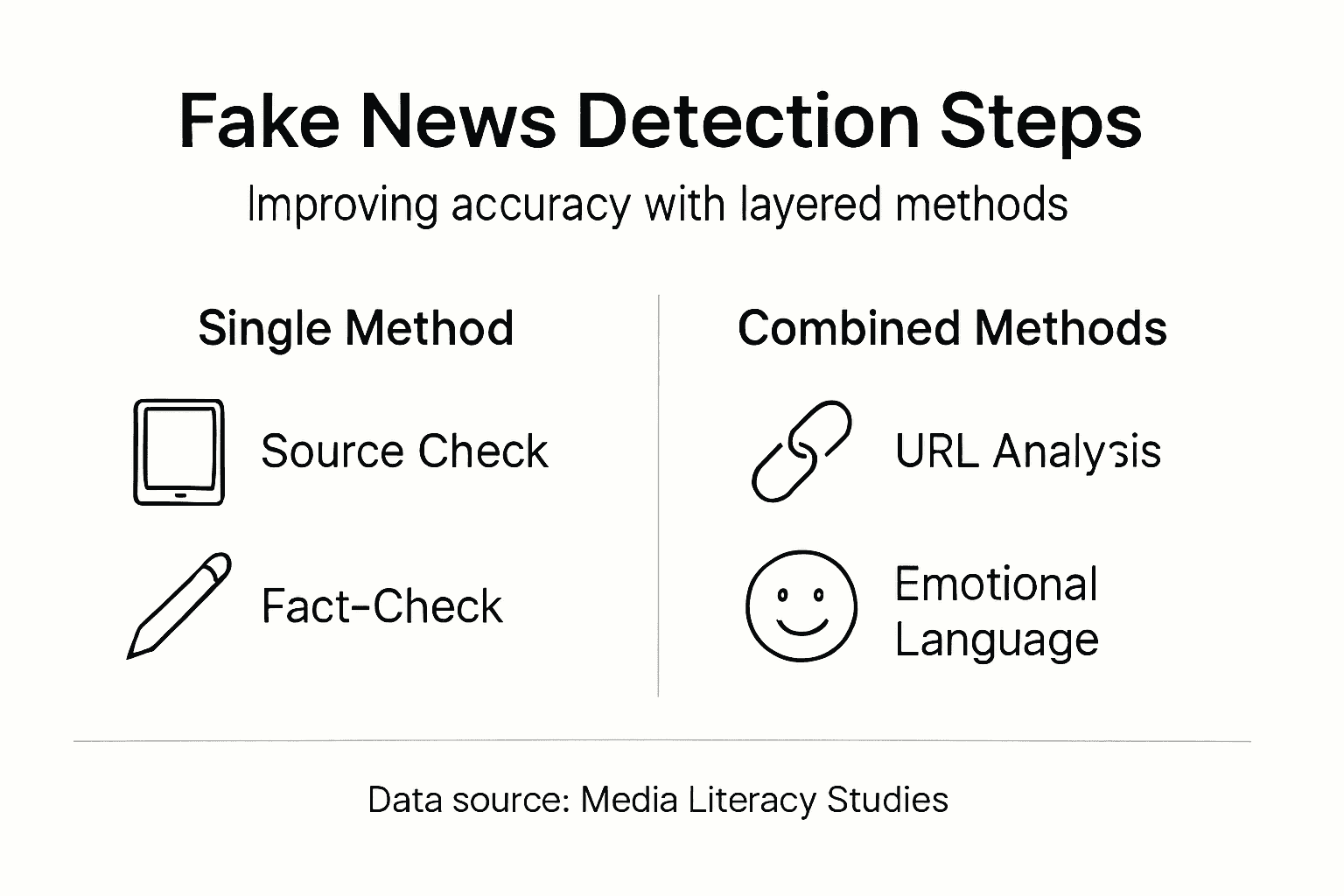
No single detection method catches all fake news, but combining approaches achieves remarkable accuracy. Evidence shows that integrating source evaluation, linguistic analysis, and cross-referencing yields detection accuracy over 80%. This multi-layered strategy catches what individual methods miss.
Single-method verification leaves blind spots that sophisticated misinformation exploits. A fake story might appear on a legitimate-looking website, pass emotional language tests, but fail source cross-checking. Another piece might come from a questionable source yet contain mostly accurate information with one critical lie embedded. Only comprehensive verification reveals these problems.
Apply your detection steps systematically to every suspicious claim. Start with source credibility checks, then analyze the language for manipulation, next use fact-checking tools, and finally cross-reference with multiple outlets. This sequence builds from quick initial filters to deeper investigation.
Single vs. Multi-Method Detection
| Approach | Average Accuracy | Time Investment | Vulnerability to Sophisticated Fakes |
|---|---|---|---|
| Source check only | 45-55% | 2-3 minutes | High – misses well-designed fake sites |
| Emotional analysis only | 40-50% | 1-2 minutes | High – legitimate news can be emotional |
| Fact-check tools only | 60-70% | 3-5 minutes | Medium – limited by tool coverage and timing |
| Combined methods | 80%+ | 8-12 minutes | Low – multiple verification layers catch most fakes |
Integration steps for maximum accuracy:
- Begin with quick source credibility assessment using URL and About page
- Scan headline and opening paragraphs for emotional manipulation patterns
- Search fact-checking sites for existing investigations of the claim
- Cross-reference core facts with three independent reputable sources
- Use reverse image search if photos accompany claims
- Synthesize findings to reach confident conclusion about credibility
Pro Tip: Create a simple verification spreadsheet tracking claims you investigate. Note which methods caught problems for each case. This personal database reveals patterns helping you develop intuition about fake news characteristics.
Step 5: Develop Healthy News Consumption Habits
Building lasting misinformation resistance requires changing daily behaviors around news consumption. Pause before sharing anything that triggers strong emotions. Take sixty seconds to verify rather than immediately hitting the share button. This simple habit dramatically reduces misinformation spread because viral fake news relies on reflexive sharing.
Always check sources before forwarding information in group chats or social media. Your credibility suffers when you spread falsehoods, even unintentionally. Friends and family trust your judgment, making you responsible for verification. When you share verified information consistently, people learn to trust content coming from you.
Commit to continuous learning as misinformation tactics evolve constantly. Fake news creators adapt to detection methods, requiring you to stay informed about new manipulation techniques. Follow media literacy organizations and read updates about emerging misinformation trends affecting your communities.
Sustainable news consumption practices:
- Set specific times for news checking rather than constant social media scrolling
- Follow diverse sources representing multiple perspectives to combat echo chambers
- Question your own confirmation bias when information aligns too perfectly with beliefs
- Discuss suspicious claims with friends who have strong critical thinking skills
- Unfollow or mute accounts that consistently share unverified sensational content
- Recognize that not knowing immediately is acceptable while you verify
Reports like those tracking information security trends demonstrate how misinformation intersects with broader digital threats. Staying informed about the digital landscape strengthens your overall media literacy.
Common Mistakes and How to Fix Them
Even careful readers make predictable errors when evaluating news credibility. Research indicates headlines mislead 40% of readers who never click through to full articles. Headlines optimize for clicks, not accuracy, making them unreliable indicators of content. Always read complete articles before forming conclusions or sharing.
Confusing satire with real news trips up 37% of young adults according to media literacy studies. Sites like The Onion clearly label satirical content, but viral social media posts strip that context. Before getting outraged, verify whether the source publishes comedy rather than journalism. Check the site’s About page and recent articles for satirical patterns to Spot Fake News.
Overreliance on single fact-checking tools creates false confidence. No organization catches every fake story immediately. Diversify your verification resources and combine tool results with critical thinking. When fact-checkers haven’t investigated a claim yet, apply other detection methods rather than assuming it’s accurate.
Ignoring article dates and lack of context causes misunderstanding even of accurate information. Old stories resurface on social media appearing current, sparking reactions to resolved situations. Check publication dates and read enough to understand full context before judging.
Mistake correction strategies:
- Read full articles, not just headlines, before forming or sharing opinions
- Verify satire sources by checking site mission statements and article patterns
- Use multiple fact-checking resources rather than trusting one exclusively
- Always check article publication dates and update timestamps
- Search for follow-up reporting that provides additional context
- Admit mistakes when you share misinformation and post corrections
Analyzing common misinformation detection mistakes in real cases shows how these errors play out. Similarly, studying examples of rumor corrections reveals the importance of verification before spreading unconfirmed reports.
Expected Outcomes and Timelines for Skill Improvement
Developing reliable fake news detection skills takes consistent practice over several weeks. Most people notice significant improvement in critical evaluation within four to six weeks of applying these methods daily. Your intuition strengthens as pattern recognition develops through repeated verification experiences.
Reaching over 80% detection accuracy becomes achievable when you consistently combine multiple verification techniques. This high success rate protects you from most misinformation while accepting that perfect detection remains impossible. Sophisticated fakes occasionally slip through, but your error rate drops dramatically compared to casual news consumption.
Practicing these skills reduces your personal misinformation sharing by at least 27% according to media literacy intervention studies. This reduction protects your credibility and stops you from amplifying lies that harm others. Beyond personal benefits, improved detection strengthens digital literacy throughout your social networks as others observe your careful verification habits.
Stronger media literacy empowers better decision-making about issues affecting your life. Political choices, health decisions, and financial judgments all depend on accurate information. Investing time in verification skills pays dividends across everything requiring informed judgment.
Discover More Tools and Resources at Blaqloaded
Navigating today’s information landscape requires reliable sources supporting your media literacy journey. Blaqloaded delivers breaking news and in-depth analysis helping you stay informed while building critical evaluation skills. Our platform curates content from credible sources, providing the context needed to understand complex stories.

Explore our latest credible news and media content covering politics, technology, entertainment, and social issues. Read detailed media analysis articles examining how information spreads and gets distorted. Engage with educational campaigns and media literacy content designed to strengthen community resilience against misinformation. Blaqloaded connects you with the resources and perspectives needed to become a more informed digital citizen.
Frequently Asked Questions About Spot Fake News
What is the first step to spotting fake news effectively?
Start by building your digital literacy foundation before attempting advanced verification techniques. Understanding basic media formats, journalistic standards, and common manipulation tactics makes all other detection methods significantly more effective. This preparation phase typically requires one to two weeks of learning but accelerates everything that follows.
Can I rely solely on fact-checking websites to detect fake news?
Fact-checking tools provide valuable assistance but prove insufficient alone for comprehensive verification. They face timing limitations on breaking stories and coverage gaps on niche claims. Combining source evaluation, linguistic analysis, and cross-referencing with fact-checking tools improves accuracy to over 80%, catching what single methods miss to Spot Fake News.
How long does it usually take to improve fake news detection skills?
Most people see noticeable improvement within four to six weeks of consistent practice applying multiple verification methods. Your pattern recognition strengthens through repeated exposure to both real and fake content. Combining techniques accelerates skill growth compared to practicing single methods in isolation.
Why does emotional content make fake news harder to spot?
Emotional manipulation bypasses rational evaluation centers in your brain, triggering immediate reactions before critical thinking engages. Misinformation creators exploit fear, anger, and moral outrage specifically because these emotions prompt reflexive sharing. Recognizing this pattern helps you pause and verify when content triggers strong feelings.
Should I fact-check everything I see on social media?
Prioritize verification for content you plan to share or information affecting important decisions. Fact-checking everything proves impractical and exhausting. Focus intensive verification on emotionally charged claims, surprising statistics, and stories perfectly confirming your existing beliefs, as these categories most often contain misinformation.
Recommended
- CrowdStrike AI Cyber Attacks Report Reveals 29 Minute Breakout Time in 2025
- AI India Summit Delivers Critical Global Approach as Leaders Call for Urgent Regulation 3
- Prophet Olujobi Prophecies 2026 Reveal Shocking Political Predictions in Nigeria
- Blaqloaded – Breaking News, Entertainment & Trending Stories