
 0
0
 0
0
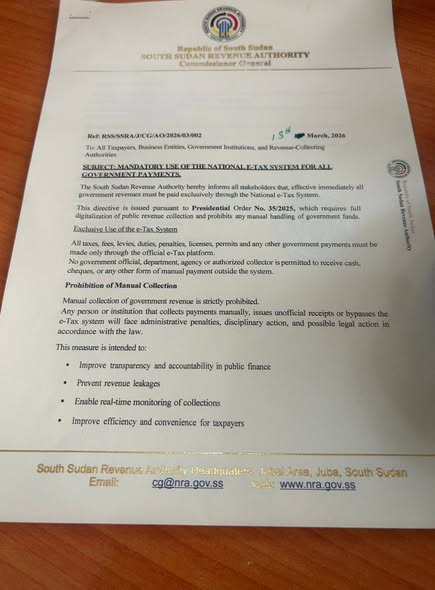
South Sudan mandatory e-Tax system implementation has been ordered by the country’s Revenue Authority, banning manual revenue collection and requiring all government payments to be processed through a digital platform.
The directive, issued by the Commissioner General of the South Sudan Revenue Authority, aims to strengthen transparency, reduce revenue leakages, and modernize the country’s tax administration.
Officials say the new system will transform the way government revenues are collected and monitored across public institutions.
South Sudan Revenue Authority Orders End to Manual Payments
Under the new directive, all government revenues must now be paid exclusively through the National e-Tax System.
This means that the following payments must be processed digitally:
-
Taxes
-
Duties and levies
-
Penalties and fines
-
Licenses and permits
-
Other government-related payments
Government officials, departments, and authorized collectors are no longer permitted to accept manual payments.
Ban on Cash and Cheque Payments
The South Sudan mandatory e-Tax system directive clearly states that no government official or institution may receive payments outside the digital platform.
The order prohibits the acceptance of:
-
Cash payments
-
Cheques
-
Any other manual forms of payment
Officials emphasized that all transactions must now be conducted through the official electronic system.
Policy Backed by Presidential Order
The directive enforcing the South Sudan mandatory e-Tax system is part of a broader government reform.
It implements Presidential Order No. 35/2025, which requires the full digitalization of public revenue collection across government institutions.
Objective of the Reform
Authorities say the transition to a digital platform is designed to address long-standing challenges in revenue management.
The reform seeks to:
-
Improve financial transparency
-
Prevent revenue leakages
-
Enable real-time monitoring of tax collections
-
Strengthen accountability in public finance
Officials believe these measures will significantly improve the management of national resources.
Penalties for Violating the Directive
The South Sudan mandatory e-Tax system directive also introduces strict enforcement measures.
Any individual or institution found violating the order may face:
-
Administrative penalties
-
Disciplinary action
-
Possible legal consequences
Violations include:
-
Collecting government payments manually
-
Issuing unofficial receipts
-
Bypassing the electronic system
Authorities stated that these rules are necessary to ensure full compliance with the digital payment system.
How the e-Tax System Works
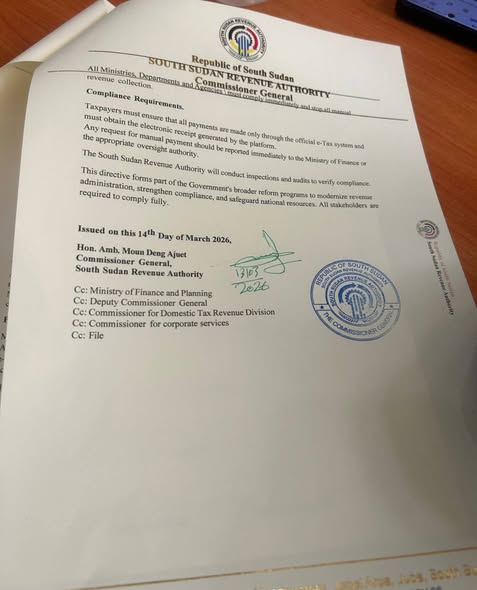
The South Sudan mandatory e-Tax system requires taxpayers and institutions to process payments through the official digital platform.
Once payment is completed, the system automatically generates an electronic receipt, which serves as official proof of payment.
Benefits of the Digital Platform
According to the revenue authority, the new system will provide several advantages:
-
Improved transparency and accountability
-
Faster processing of tax payments
-
Easier compliance for taxpayers
-
Real-time monitoring of government revenue
These features are expected to reduce administrative inefficiencies and improve public financial management.
Inspections and Monitoring to Ensure Compliance
Authorities have also announced that monitoring and inspection exercises will be carried out to enforce the directive.
Audits will verify whether government institutions and collectors are complying with the South Sudan mandatory e-Tax system requirements.
Officials will examine:
-
Payment records
-
Electronic receipts
-
Institutional compliance with digital tax procedures
These inspections are intended to ensure that all stakeholders adhere to the new system.
Major Step Toward Modernizing Revenue Collection
The introduction of the South Sudan mandatory e-Tax system marks a significant step in the country’s efforts to modernize public revenue administration.
Historically, manual tax collection practices in South Sudan have contributed to weak financial tracking and loss of public funds.
By moving to a digital platform, authorities aim to:
-
Strengthen oversight of government income
-
Improve efficiency in revenue collection
-
Reduce opportunities for corruption
The reform is expected to play an important role in improving financial governance across the country.
Government Calls for Full Compliance
Officials at the South Sudan Revenue Authority emphasized that the directive applies to all stakeholders.
Government agencies, tax collectors, businesses, and individual taxpayers must comply with the new system.
Authorities noted that the South Sudan mandatory e-Tax system is part of broader reforms designed to protect national resources and improve accountability in public financial management.
FAQ
Why did South Sudan introduce the mandatory e-Tax system?
The system was introduced to improve transparency, prevent revenue leakages, and modernize the country’s tax collection process.
What payments must be made through the e-Tax system?
Taxes, levies, duties, penalties, licenses, permits, and other government-related payments must now be processed through the digital platform.
Are cash or cheque payments still allowed?
No. The directive bans manual payments, meaning cash and cheque payments are no longer permitted.
What happens if someone collects revenue manually?
Individuals or institutions that violate the directive may face administrative penalties, disciplinary action, or legal consequences.
Conclusion
The South Sudan mandatory e-Tax system directive represents a major reform in the country’s revenue administration. By banning manual tax collection and enforcing digital payments, authorities aim to improve transparency, strengthen accountability, and ensure better management of public finances. As implementation continues, the system is expected to play a key role in modernizing South Sudan’s financial governance framework.