 0
0
 0
0
US President Donald Trump is considering sending a second aircraft carrier to the Middle East. Washington and Tehran are preparing for another round of talks. The goal is to prevent further conflict.
Military activity has increased in the region. Oman is helping both sides restart diplomatic efforts.

Diplomatic Talks Resume With Oman Mediation
Oman recently organized discussions between US and Iranian officials. Iran’s Foreign Ministry spokesperson Esmaeil Baghaei said the talks helped Tehran assess Washington’s position. He said both sides showed enough agreement to continue diplomacy.
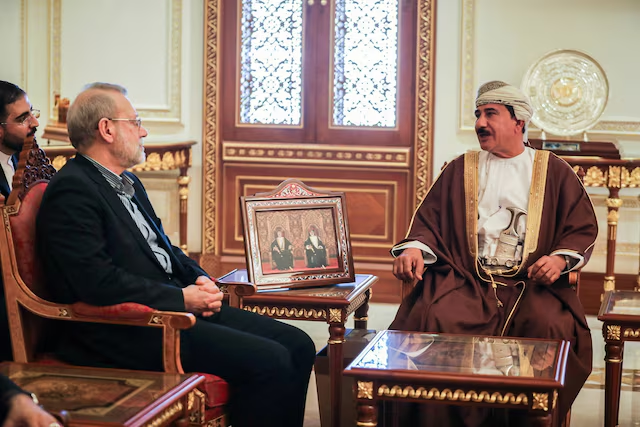
Ali Larijani serves as Secretary of Iran’s Supreme National Security Council. He also advises Supreme Leader Ayatollah Ali Khamenei. Larijani traveled to Muscat and met Omani officials.
Oman’s state news agency said both sides stressed the need for a balanced and just agreement. They also called for dialogue to promote regional and global security.
Larijani will travel to Qatar next. Doha has also played a mediating role in past Middle East crises.
Officials have not announced the date or location of the next round of US Iran talks.
Trump Signals Possible Military Reinforcement
Trump told Israeli media outlets that the United States may take tougher action if talks fail.
He also said he is considering deploying a second aircraft carrier to the Middle East. Reuters reported that officials identified the USS George Washington and the USS George HW Bush as possible options. Both ships are at least a week away from the region. The Pentagon could also deploy the USS Gerald R Ford from the Caribbean if needed.
The United States already positioned one aircraft carrier in the region. That move raised concerns about possible military escalation.
Reuters reviewed satellite images that showed a recent buildup of aircraft and military equipment across the Middle East. At Qatar’s al Udeid Air Base, US forces placed missiles into truck launchers. This allows faster movement if tensions rise.
Nuclear Program Remains Central Issue
Washington wants to expand the talks beyond Iran’s nuclear program. The United States also seeks limits on Iran’s ballistic missile development.
Iran says its missile program is non negotiable. Tehran says it rebuilt its missile arsenal after last year’s 12 day bombing campaign by Israel and the United States.
Iranian President Masoud Pezeshkian said Iran will continue to demand the lifting of financial sanctions. He also said Iran will insist on its nuclear rights, including uranium enrichment.
The United States has demanded that Iran give up its stockpile of uranium enriched to 60 percent purity. That level is close to weapons grade.
Mohammad Eslami leads Iran’s Atomic Energy Organization. He said Iran may dilute its 60 percent enriched uranium. However, this depends on whether sanctions are fully lifted.
US Vice President JD Vance said President Trump will decide the red lines in the negotiations. That includes whether the United States will allow limited uranium enrichment.
Regional and Global Implications
Israeli Prime Minister Benjamin Netanyahu is expected to meet Trump in Washington. He may push for any agreement to include limits on Iran’s missile capabilities.
Oil prices eased slightly as traders watched US Iran tensions. Markets remain sensitive to military and diplomatic signals from the region.
Iran and the United States held five rounds of talks last year about Tehran’s nuclear program. The talks stalled because of disagreements over uranium enrichment inside Iran. Since strikes hit its nuclear facilities, Iran says it has stopped enrichment activities. Tehran continues to say its nuclear program is for peaceful purposes.