 0
0
 0
0
The Sudan volunteer humanitarian crisis is deepening as local committees attempt to replace shrinking international support across the country. In cities such as Kosti, Rabak and Khartoum, volunteers are now the primary providers of shelter, food and health assistance to displaced families.
The Sudan volunteer humanitarian crisis has intensified after two years of conflict between government forces and the paramilitary Rapid Support Forces. The fighting has killed tens of thousands and displaced millions since 2023, pushing families into already overcrowded urban areas.

Displacement without structured aid
Many displaced residents arrive in host cities expecting formal humanitarian reception centres. Instead, they are met by improvised shelters run by neighbourhood groups.
In Kosti, government schools have been converted into temporary accommodation centres. These shelters are managed by local committees funded largely through remittances from Sudanese expatriates in Saudi Arabia, Kuwait and Qatar.
Kosti, located in White Nile state, now hosts more than 42 shelters and nine displacement camps. The Sudan volunteer humanitarian crisis is particularly visible here, where community members coordinate rent payments, food supplies and basic healthcare without consistent institutional backing.
Funding cuts reshape humanitarian landscape
International funding reductions have significantly worsened the Sudan volunteer humanitarian crisis. In 2025, United Nations officials described donor cuts as a major setback for humanitarian operations in Sudan.
The UN revised its global humanitarian funding appeal after substantial reductions from Western donors including the United States and Germany. The funding shortfall has forced agencies to scale back operations across the country.
According to UN estimates, more than half of Sudan’s population faces hunger, with famine conditions spreading in some areas. As formal assistance contracts, the Sudan volunteer humanitarian crisis has become more pronounced, leaving community networks to fill widening gaps.
Local initiatives take the lead
In Kosti, the For Cost neighbourhood committee provides daily meals to between 300 and 400 families. Volunteers organise food distribution, emergency shelter coordination and public health campaigns.
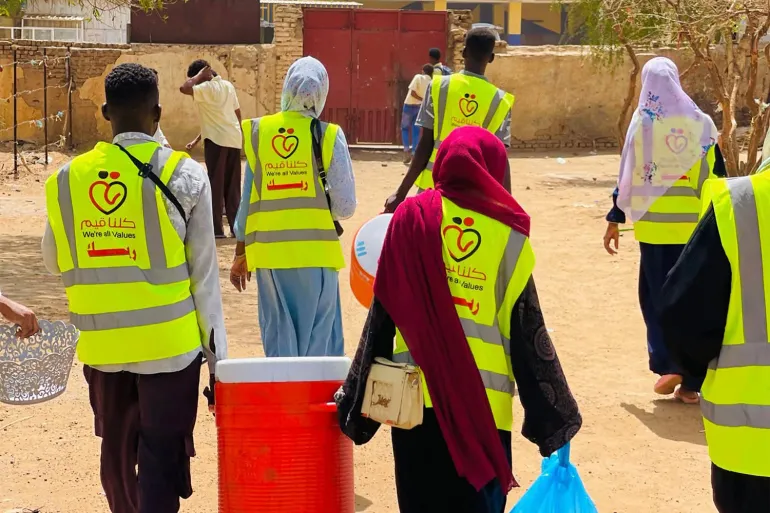
In Rabak, an initiative known as We Are All Values operates charity kitchens at displacement camps and supplies meals to patients at Rabak Teaching Hospital. These grassroots programmes demonstrate how the Sudan volunteer humanitarian crisis has shifted responsibility from international institutions to local citizens.
For displaced parents who have lost livelihoods due to fighting in South Kordofan and North Darfur, volunteer run kitchens have become essential. Meals distributed through these initiatives often represent the only reliable daily food source.

Informal shelter networks in the capital
In southern Khartoum, neighbourhood committees identify vacant houses and coordinate temporary accommodation for displaced families. These arrangements operate outside formal humanitarian systems.
Families arriving from conflict areas such as el-Fasher are provided with shelter, drinking water, food and psychological support through volunteer networks. The Sudan volunteer humanitarian crisis is especially visible in the capital, where official humanitarian presence has diminished due to insecurity and funding constraints.
Diaspora funding sustains operations
A defining feature of the Sudan volunteer humanitarian crisis is the role of diaspora remittances. Sudanese communities abroad transfer funds monthly to sustain shelters, food programmes and health outreach activities.
However, volunteer coordinators warn that declining global humanitarian engagement directly limits the number of families they can support. As displacement increases, available resources are stretched thinner.
Despite these pressures, community leaders emphasise that displaced families often arrive in extreme distress. Volunteers continue to operate kitchens, organise shelters and coordinate donations to prevent deeper humanitarian breakdown.

Sustainability remains uncertain
From converted schools in Kosti to camp kitchens in Rabak and informal housing networks in Khartoum, the Sudan volunteer humanitarian crisis reflects a nationwide shift toward community driven relief.
While these efforts have prevented further suffering, long term sustainability remains uncertain. Without renewed international funding and structured coordination, local networks may struggle to keep pace with rising displacement and food insecurity.
As conflict continues to reshape Sudan’s demographic landscape, the Sudan volunteer humanitarian crisis highlights both the resilience of communities and the risks of prolonged underfunding in one of the world’s most severe humanitarian emergencies.
For more news, please visit our homepage