 0
0
 0
0
Russian Spy Spacecraft Suspected of Intercepting European Satellite Communications
European security officials believe Russian spy spacecraft have intercepted communications from several critical European satellites, raising concerns about data security and potential disruption of space infrastructure.
Officials say at least a dozen satellites operating over Europe may have been targeted. These interceptions could expose sensitive information and may allow hostile actors to interfere with satellite operations, including altering their orbits or disabling them.
Increased Russian Activity in Orbit
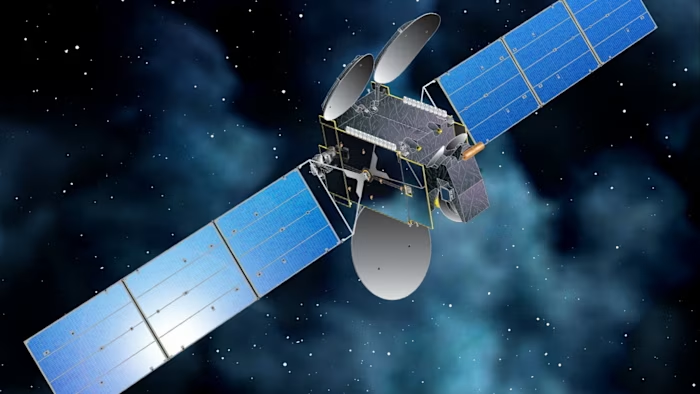
Western military and civilian space agencies have monitored two Russian satellites, known as Luch 1 and Luch 2, for several years. The spacecraft have carried out repeated close approaches to European geostationary satellites, which provide services across Europe, the United Kingdom, Africa, and parts of the Middle East.
Since 2023, Luch 2 alone has approached at least 17 European satellites. Observations show that the Russian spacecraft often remain near their targets for weeks, especially during the past three years amid heightened tensions following Russia’s invasion of Ukraine.
Concerns Over Unencrypted Satellite Data
European intelligence officials believe the Luch satellites are positioned to intercept data beams sent between ground stations and satellites. Many older European satellites transmit unencrypted command data, making them vulnerable to interception.
This exposure could allow adversaries to record command signals and potentially reuse them later to interfere with satellite controls. Such interference could include sending false commands to adjust satellite thrusters, disrupt positioning, or even force satellites out of orbit.

Broader Security Risks
Officials link these space activities to Russia’s wider hybrid warfare tactics in Europe, including sabotage of undersea internet and power cables. Intelligence agencies warn that similar disruptive actions could extend further into space operations.
German defense officials have described satellite networks as a critical weakness for modern societies, warning that attacks on space infrastructure could disrupt entire nations.
Civilian and Government Impact
Most of the satellites approached by Luch 1 and Luch 2 serve civilian purposes such as television broadcasting. However, they also carry government and limited military communications, increasing the potential impact of any data compromise.
While analysts believe the Russian spacecraft cannot directly destroy satellites, the data collected could support future jamming or hacking operations from Earth or orbit.
Ongoing Monitoring and New Launches
Space tracking companies report that Luch 2 remains close to Intelsat 39, a major satellite serving Europe and Africa. Analysts also note that Russia has launched additional maneuverable satellites, Cosmos 2589 and Cosmos 2590, which appear capable of similar reconnaissance missions.
Cosmos 2589 is currently moving toward geostationary orbit, approximately 35,000 kilometers above Earth, according to orbital analysts.
Possible Failure of Luch 1
Recent ground-based telescope observations suggest that Luch 1 may no longer be fully operational. On January 30, observers detected what appeared to be a gas plume from the satellite, followed by partial fragmentation and unstable movement.
European and allied space agencies continue to monitor these developments closely amid growing concerns over space security.