 0
0
 0
0
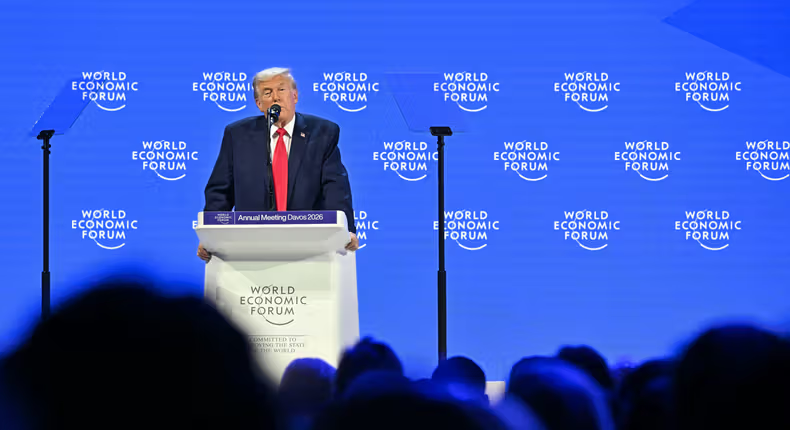
President Donald Trump delivered a wide-ranging, 70-minute speech at the World Economic Forum in Davos, Switzerland, on Wednesday, drawing intense scrutiny from global business leaders, investors, and political figures.
Within hours of the address, prominent CEOs and economists began weighing in through interviews and social media. Much of the reaction centered on Trump’s renewed push to negotiate US control over Greenland, an issue that has dominated this year’s Davos discussions and raised concerns across Europe.
Trump told attendees he would not use military force to acquire Greenland but said the US was seeking immediate negotiations to revisit the idea of acquisition. His comments kept global attention fixed on Congress Hall, which was filled with heads of state and top executives, including Apple CEO Tim Cook and Salesforce CEO Marc Benioff.
Ken Griffin: Europe Must “Do Better”

Citadel founder and CEO Ken Griffin said Trump’s speech carried a blunt message for European leaders.
Speaking on CNBC’s Squawk Box, Griffin said Trump was addressing an economic reality that Europe has struggled to confront.
“Europe’s economic growth lags far behind America,” Griffin said, adding that public support for national defense appears far weaker in Europe than in the US.
Griffin pointed to Trump’s argument that US access to Greenland is tied to broader questions of collective security, including whether European allies would fully support the US in a future conflict.
However, Griffin cautioned against rushing negotiations, stressing the importance of stability for global markets.
“Investors around the world do not want to see an escalation of stress in global trade,” he said, noting that any major geopolitical move should be approached deliberately.
Peter Schiff: Buying Greenland Would Mean Overpaying

Peter Schiff, chief economist at Euro Pacific Asset Management, said Trump’s remarks suggested restraint compared to earlier rhetoric.
“It looks like cooler heads prevailed at the White House,” Schiff wrote on X, referring to Trump’s rejection of military force.
Schiff argued that while diplomacy is preferable, a purchase would likely come at an excessive cost.
“If we do succeed in buying Greenland, we’ll massively overpay,” he wrote.
Beyond geopolitics, Schiff also seized on Trump’s comments about the US housing market. He warned that the president appeared to acknowledge the existence of a housing bubble while signaling efforts to prevent it from bursting.
“Once you recognize a bubble, the worst thing you can do is try to sustain it,” Schiff said, predicting a future housing market crash.
Matthew Prince: A Different Trump at Davos

Matthew Prince, CEO and cofounder of Cloudflare, focused less on policy and more on Trump’s delivery.
Writing on X, Prince noted a sharp departure from Trump’s previous Davos appearances.
“Last two times Trump spoke at Davos he stuck extremely close to the teleprompter,” Prince wrote. “Not this time.”
His comment echoed a broader sentiment among attendees that Trump’s speech felt more free-form, expansive, and confrontational than in past years.
Greenland Dominates the Conversation
Trump’s comments on Greenland overshadowed much of the forum’s economic agenda. His repeated pressure on Europe and insistence that Greenland plays a vital role in US security strategy have unsettled diplomats and business leaders alike.
While Trump framed his position as a strategic necessity, critics argue the rhetoric risks destabilizing transatlantic relations at a time of heightened global tension.
As Davos continues, business leaders are watching closely to see whether Trump’s words translate into concrete policy—or further strain on already fragile international alliances.