0
0
 0
0
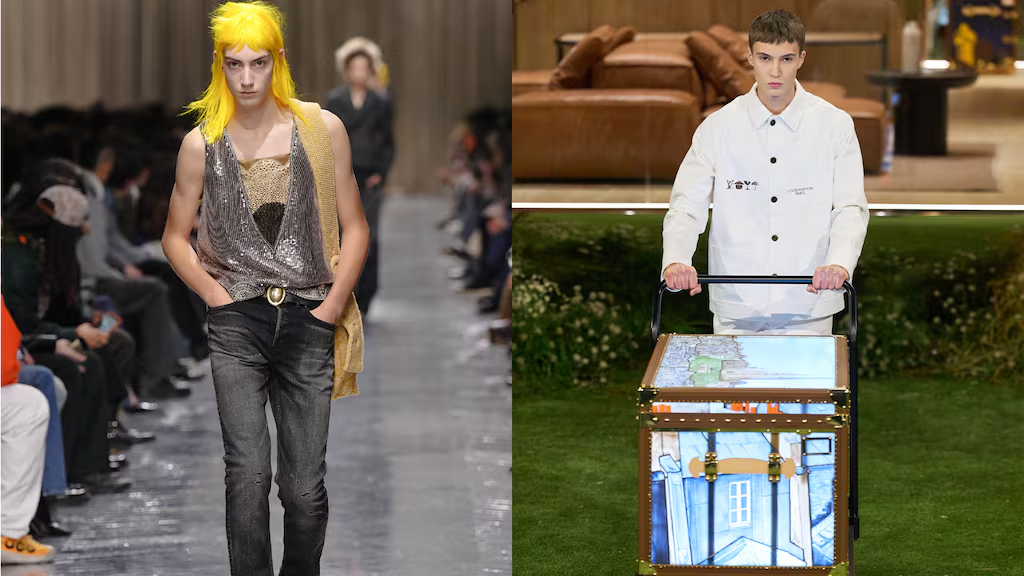
Luxury no longer means what it once did. The traditional signals of wealth—perfect tailoring, quiet refinement, and timelessness—are being challenged by new ideas shaped by social media, youth culture, and global uncertainty. This menswear season, Louis Vuitton and Dior, the two crown jewels of the LVMH empire, offered sharply contrasting visions of what luxury looks like now—and where it might be heading.
Both brands command enormous cultural and financial power. Yet their runway statements revealed very different philosophies. One leaned into spectacle, speed, and cultural noise. The other doubled down on craft, heritage, and restraint. Together, they illustrated a luxury industry caught between transformation and tradition.
Louis Vuitton: Luxury as Cultural Power
At Louis Vuitton, menswear continues to operate as a cultural engine rather than a purely fashion one. Under Pharrell Williams, the brand has embraced a version of luxury that feels loud, accessible, and deeply embedded in pop culture.
This season’s collection leaned heavily into recognition over refinement. Logos appeared boldly. Silhouettes felt oversized and relaxed. Materials mixed the precious with the playful. It was fashion designed not just to be worn, but to be seen, photographed, and shared.
Pharrell’s Vuitton speaks to a generation raised online. Status today comes from visibility as much as wealth. Wearing Louis Vuitton signals cultural relevance, not just financial success. The brand understands this shift and has adapted accordingly.
There was also a deliberate blurring of boundaries. Streetwear codes merged with traditional luxury craftsmanship. Tailoring sat alongside sportswear. Accessories carried as much weight as clothing. Everything pointed to a future where luxury functions as a global language, instantly readable across cultures.
Critics may question whether subtlety has been lost. But Vuitton’s success suggests that subtlety is no longer the primary goal. In a crowded digital landscape, luxury brands must compete for attention. Louis Vuitton has chosen to win by being unmistakable.
Dior: Luxury as Discipline and Craft
Dior took a markedly different path. Its menswear presentation focused on precision, proportion, and control. Where Louis Vuitton chased energy, Dior pursued clarity.
The collection emphasized sharp tailoring, elegant lines, and carefully considered materials. Colors remained muted. Details rewarded close inspection rather than instant recognition. This was luxury meant to be understood slowly.
Dior’s message was clear: true status does not need to shout. In a world of constant stimulation, restraint itself becomes a form of power. The clothes projected confidence through calmness, suggesting a wearer who does not need validation.
This approach reflects Dior’s deep connection to traditional luxury values. Craftsmanship mattered here. So did continuity. The collection felt anchored in the house’s history while remaining modern in execution.
Yet Dior was not nostalgic. The designs avoided stiffness. Proportions evolved subtly. Fabrics moved with the body. The result felt contemporary without chasing trends.
For Dior, luxury remains about time, skill, and intention. It speaks to consumers who value discretion and depth over speed and scale.
Two Visions, One Market
The contrast between Louis Vuitton and Dior highlights a larger truth about luxury today: there is no single definition anymore.
Some consumers seek visibility. Others crave authenticity. Some want their clothing to broadcast identity. Others prefer it to signal discernment. LVMH understands this diversity better than most, which is why it allows its brands such creative freedom.
Louis Vuitton thrives in a world driven by hype, collaboration, and cultural crossover. Dior flourishes in moments that reward patience and refinement. Both approaches succeed because they speak to different emotional needs.
Importantly, neither brand is “right” or “wrong.” They simply answer different questions. Vuitton asks how luxury can remain dominant in popular culture. Dior asks how it can retain meaning in a noisy world.
What Luxury Really Means Now
Luxury today is less about exclusivity alone and more about alignment. Consumers want brands that reflect how they see themselves—or how they want to be seen.
For some, that means embracing boldness, visibility, and modernity. For others, it means choosing discretion, quality, and timelessness. The market is large enough to hold both impulses.
What matters most is credibility. Brands must commit fully to their vision. Half-measures fail quickly in an era of constant comparison.
This season, Louis Vuitton and Dior showed what commitment looks like. One embraced the present at full volume. The other refined the past for the future. Together, they proved that luxury’s power lies not in uniformity, but in contrast.
As tastes continue to evolve, the most successful luxury houses will be those that understand not just what people wear—but why they wear it.
And for now, LVMH’s two biggest brands are asking that question in very different, very compelling ways.