HALEU Nuclear Fuel Partnership Advances Next Generation Reactor Development
Posted on
Necsa nuclear facility in Pelindaba North West Province
0
0
Read Time:5 Minute, 19 Second
HALEU Nuclear Fuel Partnership discussions have moved into implementation stage following a pre implementation services contract agreement between Quantum Leap Energy and the South African Nuclear Energy Corporation. The agreement marks a significant step toward research, development, and future commercial production of high assay low enriched uranium.
The collaboration involves Quantum Leap Energy, a subsidiary of ASP Isotopes, and South African Nuclear Energy Corporation. The initiative focuses on strengthening global supply chains for advanced nuclear fuel required in next generation fission reactors.
Agreement Framework and Facility Development
Under the HALEU Nuclear Fuel Partnership, Necsa will provide access to facilities, infrastructure, utilities, and related services at its Pelindaba site in the North West Province of South Africa. The site will support the siting, design, construction, commissioning, and operation of a uranium enrichment facility.
The partnership establishes a joint coordination committee consisting of two representatives from Quantum Leap Energy South Africa and two from Necsa. This committee will oversee governance, implementation, and compliance throughout the project lifecycle.
The HALEU Nuclear Fuel Partnership is designed to move Quantum Leap Energy closer to market readiness for high assay low enriched uranium production.
Necsa nuclear facility in Pelindaba North West Province
Research and Technology Integration
A key objective of the HALEU Nuclear Fuel Partnership is to combine proprietary enrichment technology licensed by Quantum Leap Energy with Necsa’s established nuclear infrastructure and decades of operational experience.
The Pelindaba site provides an internationally recognised nuclear research and development environment. Through this collaboration, Quantum Leap Energy will conduct enrichment research activities while leveraging Necsa’s technical capabilities and operational networks.
The partnership will operate under strict site regulations, safety protocols, and security requirements enforced by Necsa. It will also require approvals from the National Nuclear Regulator and other relevant authorities before full scale commercial activities begin.
Supporting Global HALEU Supply Chains
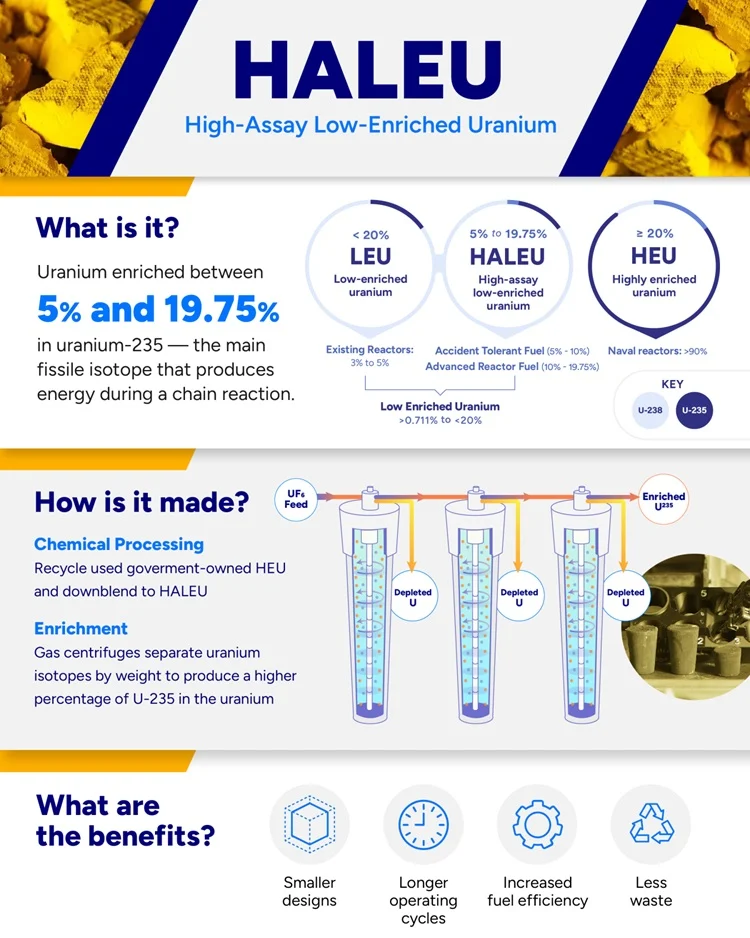
The HALEU Nuclear Fuel Partnership comes at a time when demand for advanced nuclear fuel is increasing worldwide. High assay low enriched uranium is essential for small modular reactors and other advanced reactor designs that promise improved efficiency, enhanced safety features, and lower carbon emissions.
Advanced reactors are being developed globally to meet rising clean energy demands, particularly for AI driven data centres, industrial electrification, and stable baseload power supply. Reliable HALEU supply chains are considered critical to ensuring these technologies can be deployed at scale.
The partnership aligns with Necsa’s strategic framework to optimise its nuclear fuel capabilities and strengthen its position in the global nuclear value chain.
Market Demand Projections
According to estimates from the US Department of Energy, the United States alone could require approximately 50 tonnes per year of HALEU by 2035 to support its commercial nuclear power industry. That demand is projected to rise to 500 tonnes per year by 2050.
These projections highlight the importance of developing diversified and secure HALEU supply sources. The HALEU Nuclear Fuel Partnership aims to contribute to meeting this anticipated demand by expanding enrichment capacity outside traditional suppliers.
As more countries invest in next generation nuclear reactors, global competition for enriched uranium is expected to intensify. Establishing additional enrichment facilities in stable jurisdictions may enhance energy security and reduce supply chain vulnerabilities.
Strategic Importance for ASP Isotopes
For ASP Isotopes, the HALEU Nuclear Fuel Partnership represents a transition from planning to implementation. Access to Pelindaba’s nuclear infrastructure allows the company to accelerate commercial timelines and strengthen its market position in the advanced nuclear fuel sector.
Quantum Leap Energy leadership has indicated that the collaboration is intended to provide a reliable HALEU supply for next generation reactors. The company aims to support growing global market demand through scalable enrichment operations.
This partnership builds upon a previously announced memorandum of understanding between the two organisations. The current agreement formalises pre implementation steps and sets the stage for more advanced operational milestones.
Necsa’s Role and Long Term Vision
Necsa brings more than six decades of experience in nuclear technology, materials development, and international distribution networks. Through the HALEU Nuclear Fuel Partnership, Necsa intends to optimise its global relationships and complementary enrichment capabilities.
The organisation has positioned itself on a growth and expansion trajectory, with collaboration forming a central part of its strategy. By working with Quantum Leap Energy, Necsa aims to broaden market reach and explore new commercial avenues within the nuclear fuel sector.
The partnership also reinforces South Africa’s strategic importance within the global nuclear landscape. Pelindaba has long served as a central hub for nuclear research and production, and this initiative may further enhance its international profile.
Regulatory and Compliance Considerations
The HALEU Nuclear Fuel Partnership will remain subject to regulatory oversight. Compliance with national nuclear safety standards, environmental regulations, and international safeguards will be mandatory.
Before full scale enrichment operations commence, approvals from the National Nuclear Regulator and other relevant bodies must be secured. These regulatory frameworks are essential to ensuring safe and secure handling of nuclear materials.
Safety, transparency, and adherence to international nuclear norms are expected to be central components of the project’s implementation phase.
Broader Impact on Advanced Nuclear Energy
The HALEU Nuclear Fuel Partnership reflects a broader shift toward advanced nuclear technologies designed to meet future energy needs. Small modular reactors and other advanced systems require fuel enriched beyond traditional commercial levels but below weapons grade thresholds.
High assay low enriched uranium enables improved reactor efficiency, longer fuel cycles, and enhanced operational flexibility. These features make HALEU a critical component of emerging nuclear energy strategies worldwide.
As countries pursue carbon reduction targets and energy diversification, advanced nuclear reactors may play an increasingly important role in delivering stable, low emission electricity.
Outlook
The HALEU Nuclear Fuel Partnership between ASP Isotopes subsidiary Quantum Leap Energy and Necsa marks a structured step toward expanding global enrichment capacity. By combining proprietary enrichment technology with established nuclear infrastructure, the collaboration aims to strengthen supply reliability for next generation reactors.
With projected demand for HALEU rising sharply over the coming decades, strategic partnerships such as this may influence the pace and scale of advanced nuclear deployment globally.
The coming phases will focus on regulatory approvals, facility preparation, and technical integration. If successfully implemented, the HALEU Nuclear Fuel Partnership could contribute meaningfully to diversified nuclear fuel supply chains and support the transition toward cleaner and more resilient energy systems.
Apple has once again claimed the title of the world’s most valuable brand. According to a new ranking released by brand consultancy Brand Finance, the […]
The NAFDAC SMA Gold alert has raised concerns among healthcare providers, caregivers, and the public following the discovery of illegally altered manufacturing and expiry dates […]



 0
0
 0
0